Personal Reflection #1
On unknowingly growing up emotionally stunted...

I did not grow up familiar with the taste of salt water. In the house where I was raised, crying was an act of ingratitude.
“You could have been born an orphan. You could have been born blind or deaf. You could have been born poor. Be grateful.”
“Oh you got hurt? At least you did not lose an arm or a leg. Be grateful.”
So much of my childhood is still vivid; bright technicolor, easy to reach, to grab, to recall in mind, body, spirit, and heart. Every hurt, every laugh, every moment of terror and joy.
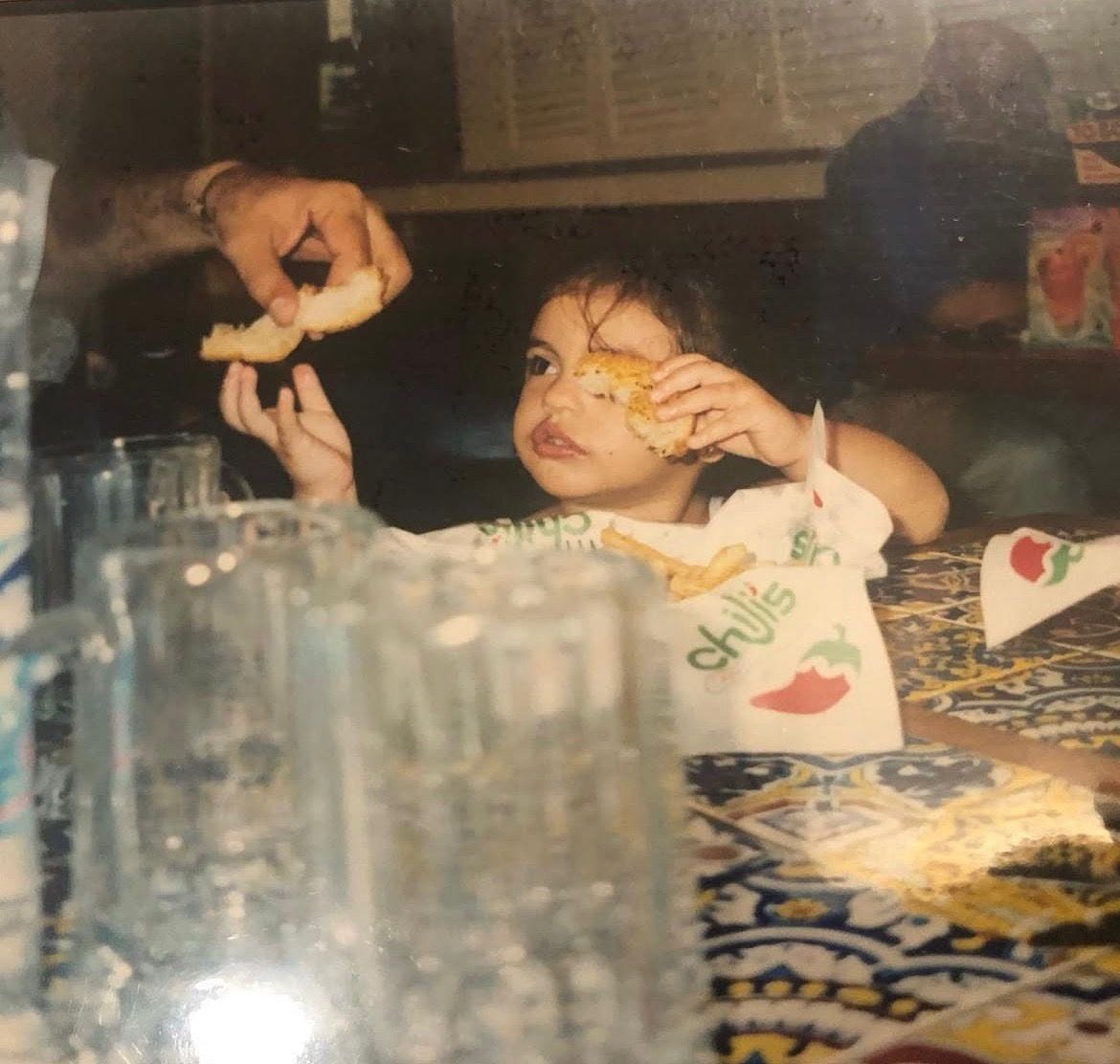
Once, sometime before my eighth birthday, I was experiencing my first friendship breakup and I felt so hurt, I cried on a day Baba was home.
He came into my room, knelt down, gently clutched my shoulders, looked me in the eye, and said, “Only weak girls cry. Will it take away the hurt? Will it bring back your friend? Make them like you again?”
I shook my head. He nodded.
“I never want to see you cry again.”
When I told Kooky, she taught me to make tea compressions, so if I did cry, he would never find out. Often, I’d hold everything in until Friday morning, where I would rush to her house, climb into her bed, burrow myself in her arms, and let it all out.
Baba never cried in my childhood, but he was prone to epic fits of rage (he still is). In those moments; face fire-engine red, veins popping and purpling, fists clenched white…he resembled, to my young mind, a monster. Nothing about him seemed human.
And, well, I was a child, so I emulated.
Anger became my best friend. It is the easiest emotion for me to tap into. Wrap it around myself like armor, or a weighted blanket, hold it close like a plushie, or a pistol. Weaponize it, demobilize it, twist it, turn it, flip it, charge it.
It’s mine.
A safety blanket made of barbed wire wrapped around my ribs, curved bones encased, scratching red flesh with each breath, spilling crimson in the caveae between; (is it not the height of irony that cavea [singular], the Latin root of caveat, means both a hollow and a cage?), where it fills me up and simmers. Always ready to spit and bubble, to rise up and up and up, drown lungs and coat throat, crawl up esophagus, lingering, daring, twisting, a hot, writhing mess of bitterness and pleasure, demanding to claim. My life, possibly. To die choking on my father’s inheritance.
Or to be gargled and spit. To splash someone else red, to tarnish them, cloak them, drown them. My red. To hurt because I hurt. To rage because I rage. To smile, after, with bloodied teeth, to let it drip down my chin, jaw, neck, breast, belly, womb. To be relieved at no longer holding the red in. To feel pleasure because someone else is coated in red now, too.
To know, that I am no longer alone, if for a breath.
bell hooks’ All About Love became my lifeline for a while because I could not bear to do this to friends, loved ones (but I did). I tried so hard to cling to the idea of love she presented, to think about community building genuinely. But this is one thing I could not think myself into feeling or knowing. Not when I was terrified of what acknowledging that my rage is manufactured might do to me.
Until my university years ended, I very rarely cried. Looking at photos of Maspero or Rabaa, or footage of El-Sarout singing during the siege of Homs, or when a boy broke my heart (though, that in itself was a rare occasion).
In the face of the genocidal war on Gaza, however, I crumbled.
Within the first hours, I was sobbing. The dam broke, entirely. Years of conditioning thrown out the proverbial window.
Crying became instinctive, somehow.
A bomb fell on Gaza? Cry. A child was shot in the West Bank? Cry. A friend was forcibly disappeared? Cry. Got criticized? Cry. Heard Haitham chant at a protest? Cry. Friend released from prison? Cry. Write a news story about tortured Palestinian prisoners? Cry. Read about tortured prisoners in Egypt? Cry. Price hike? Cry. Witness a car accident? Cry. An injured puppy? Cry. Tamim reciting أيا ياسمين التي من حلب? Cry. Re-read Graffiti for Two? Cry. Drag Ahmed into a conversation on love? Cry. Miss my friends? Cry. Stressful work day? Cry. But all work days are stressful because news room, in Cairo, during relentless wars. So, I cry every day now.
Someone tells me they love me? Cry. So hard.
Because I do not believe it, and I wish I could.
A year ago, during a therapy session, my former therapist asked me, “do you really think your rage is so easy to access because it’s at least partially real? Or could you be feeling another negative emotion and rage is what you act out?”
“Like, hurt? Sadness?” I asked.
“Maybe something deeper? Think on it,” she said.
Over the next couple of months, I would come to recognize that my rage is synthesized out of something else entirely. It is not a byproduct of a myriad of other negative feelings. Rather, it is the easiest replacement for something I learned from my Baba.
Shame.
I am constantly battling my own sense of inadequacy; the sense that all I do humiliates myself, and by extension, my Baba.
My first love. The one man I trust. The only “I’m proud of you” that has ever mattered to me. The person who first made me cry and first made me laugh; who spat his blood at me for not acing Math tests, who made me lunchboxes with all my favourites always. The person who’d run to wherever I was playing a basketball match mid-work to criticize my performance and cheer me on, “because I love you enough to do so, because you need to be better.”
In therapy, I learned to recognize that my first reaction, what I’d long mistaken for instinct, was conditioning.
You see, if this is a learned behaviour, it means that I can unlearn it.
I am entirely capable of detangling my insides and rearranging them how I want.
I do not think I have, ever in my life, arrived at a more joyful conclusion.
The biggest roadblock, however, is the big question: how [who] do I want to be?
I do not have a complete answer, and anyhow, I believe my answer will (d)evolve with me as I age.
But I like crying.
Salt water carries none of the bitterness, the rust, of blood. It ebbs and flows. Washes dirt and sediment off my heart. Gently burns my face in punishment, a welcome flagellation, a fleeting one. A declaration of my empathy, my humanity.
My prophet—may my loved ones and I be reunited with him in the hereafter, may we drink from his palms and be shaded by his love—said, “People whose hearts are like the hearts of birds will enter Paradise.”
In Arabic, the hadith does not use the term quloob, the plural term for qalb, which means heart. My prophet used af’eda, the plural term for fou’ad.
In Islamic teachings, the qalb is the organ; home of logic, faith, and security. The qalb acts as the mind and contains the soul.
The fou’ad is the heart of the heart. Its deepest crevice. Home of sorrow, passion, fear, rage, and love. It is the most tender place in the (meta)physical human body.
Our af’eda are, apparently, directly tied to our tear ducts; to cry is to have a present heart.
It is, then, entirely unsurprising that I cry every time I remember these words, written by Imam Al-Shatibi over 400 years ago:
وَلَوْ أَنَّ عَيْنًا سَاعَدتْ لتَوَكَّفَتْ..سَحَائِبُهَا بِالدَّمْعِ دِيمًا وَهُطّلاَ
وَلكِنَّها عَنْ قَسْوَةِ الْقَلْبِ قَحْطُهاَ..فَيَا ضَيْعَةَ الأَعْمَارِ تَمْشِى سَبَهْلَلاَ
I think that it is interesting I arrived here. I planned to write none of this. But I was yearning for a hug from someone I love so much, it hurt. Partly due to my ADHD, I am averse to most touch. I can do customary air kisses, if pushed. But proper hugs? I have to love you viscerally.
Touch starvation is a gnawing beast, curling tighter around itself to better coil around me. Touch starvation, like rage, demands my blood. Whispers, over and over and over until my nails are scratching down my arms, trying to sate it, knowing it will not let me go until I make ribbons out of my own skin.
And I did not realise I was crying with the pain of starvation until I tasted salt on my tongue.
A hug is, at its core, permission to go soft, pliable. To let go. To not have to hold myself up. To be cradled, for a moment, in someone else’s heart. To taste their love. To be wrapped in it as it penetrates my skin and flesh and blood, winds its way up my brain and down my lungs, permeates every nook, silencing the vicious voices in my head and kissing the bruises on my heart.
It is only when I am hugged that I believe I am loved.
Good night,
Fadila
P.S. I love hugs from Baba, and he always obliges when I ask. He taught me what he was taught, and I am blessed to know better now [by the way, he encouraged me to go to therapy and waited for me at the clinic during my first visit because I was scared to go by myself.]
The only reason I am publishing this, when it is a disjointed, ugly fucking mess, is because I am exhausted. And I will not write unless I throw myself in the deep end. To demand you, reader, look at the viscera spilling from my belly and the exposed nerve endings in my skull. Exposure therapy, if you will.
[Maybe, some other time, I will go into why and how comradeship is reshaping my relationship with myself and the world, how it means more to me than friendship. How good it feels to know that even if I do not feel like showing up for myself, I have to show up for my comrades, for my cause, for something so much bigger than me. Bonded by comradeship is the most liberated I have ever felt, the most loved, the most loving. But that is a mess to (attempt to) unpack on another sleepless night.]
So beautiful, feels like eldest daughter experience, thank you ❤️
This’s beautiful. Thank you💓💐.